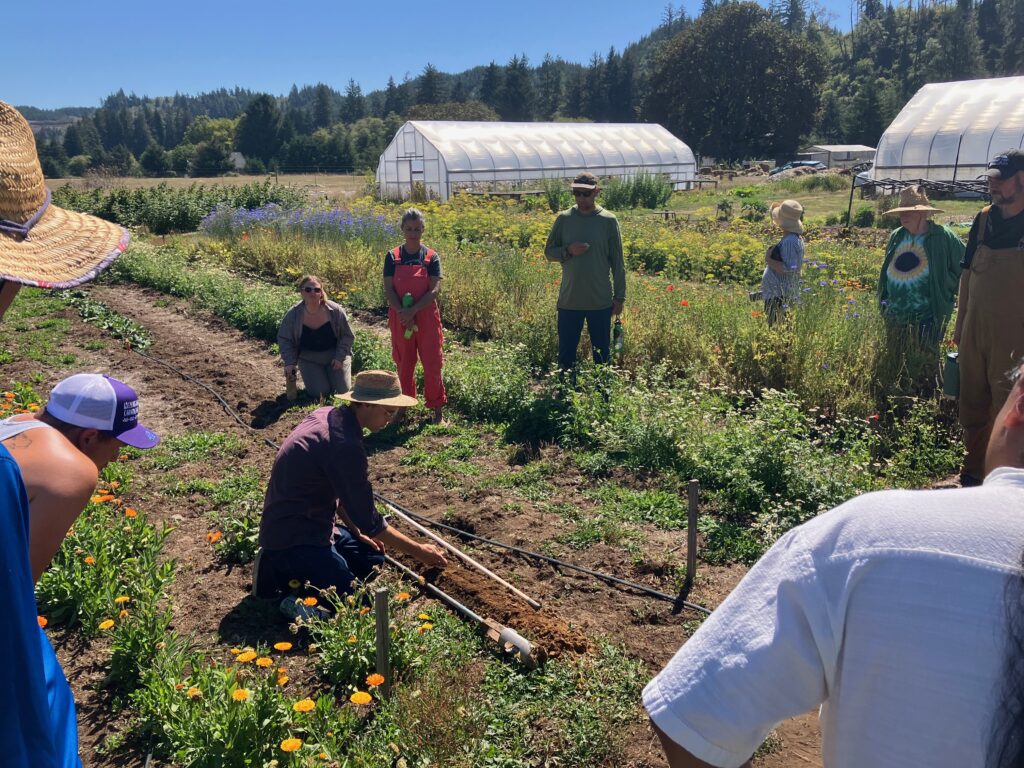
In August of 2015, Oregon State University hosted its first dry farming field day. It was an extreme drought year. Wells were running dry, and water rights were being restricted. More than 100 farmers, researchers, and curious growers showed up. Standing in a field of thriving, unirrigated crops, the question that was persistently asked throughout the day was:
“How many times did you irrigate?”
The answer was that we didn’t.
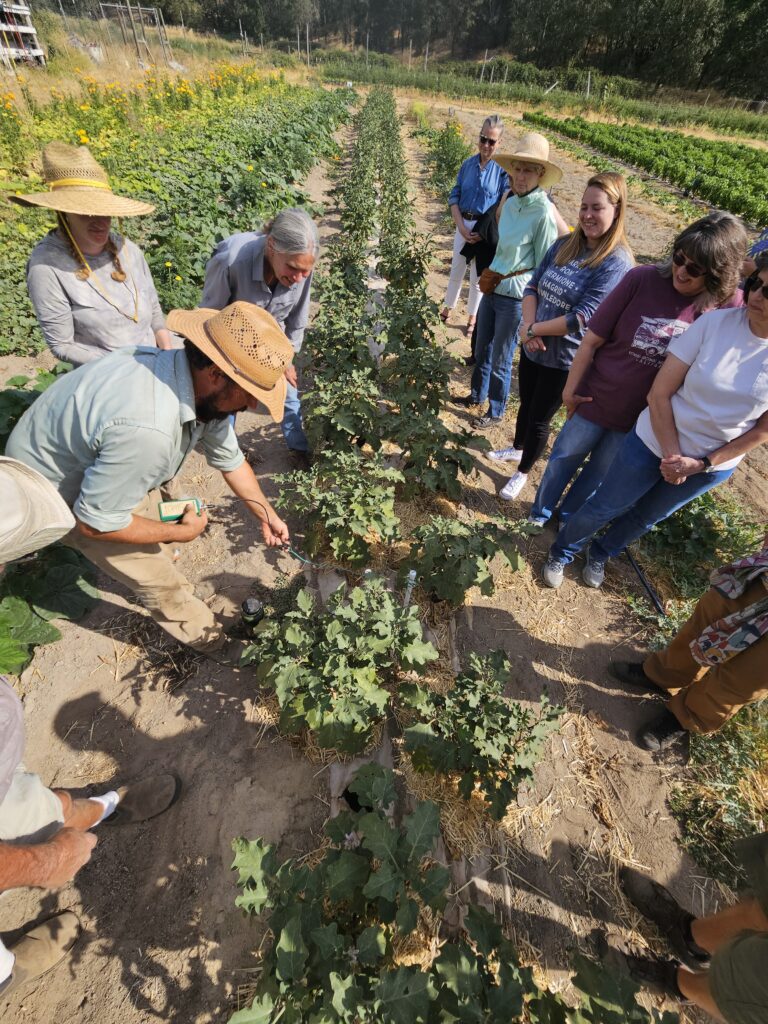
Examining a soil core. Photo by Amy Garrett
What followed was a moment of collective realization. Participants learned that nothing grows without water, but that the right varieties of plants, planted at the right time, given the right conditions, will root deeply and draw on moisture stored in the soil from winter rains. No irrigation is required.
The paradigm shifted that day for those field tour participants.
More than 90% of participants left that day saying they intended to start experimenting with dry farming on their own.
A Nontraditional Kind of Group
What made, and still makes, the Dry Farming Collaborative (DFC) distinctive is the blurring of the traditional boundaries between researchers and farmers. In speaking about the DFC, a participant described it:
“Yeah, I think that the line gets blurred quite a bit… It’s kind of a nontraditional kind of a group, in that respect… and I think that’s useful in a lot of ways.”
And another:
“I think that they’re trying to learn from each other and it’s a mutually beneficial relationship… with the people learning from each other, becoming better, more efficient at what they’re doing and what they’re pursuing for the greater good of dry farming and how it can be implemented on a larger scale.”
— Parks et al., “Bridging scientific and experiential knowledges via participatory climate adaptation research: A case study of dry farmers in Oregon
Nobody owns this community. We’re partners in contributing to a shared body of knowledge that will support us in adapting over the long term to changing, growing conditions.
A Community Forms
Many of those participants experienced their wells running dry that summer. Others had their irrigation restricted by the watermaster due to drought conditions. They were curious, but really, they were driven by a need to remain viable.
To support this group, the Dry Farming Collaborative was born. We primarily engage as a Facebook group, through a listserv, and annually at field tours and our winter convening.
Those early discussions became so much more. Growers shared photos, asked questions, and learned from farmers with decades of dry farming experience. What started as a mostly Western Oregon group quickly grew to include participants and contributors from around the world. People are exploring dry farming in radically different climates and contexts, and we continue to learn from regions where dry farming has long been practiced.
The annual Winter Convening began as 40-60 people gathered at a grange hall, sharing seeds, a potluck of dry-farmed produce, and what they’d learned that season. During the pandemic, we were forced to shift to a virtual platform. We did not expect it to gain as much traction as it did. Now, we average 200+ attendees from across the Pacific Northwest and beyond.
From Moment to Movement
The Dry Farming Collaborative formalized something that was already happening. We catalyzed the opportunity for farmers and researchers to learn alongside each other, asking questions together, sharing seeds and hard-won information from our collective experiences across state and county lines.
The Dry Farming Institute was founded in 2019 to give this work an independent home nimble enough to be accountable to the growers who showed up on that August afternoon and to the many who continue to show up and explore how we can thrive with less water.
We had a moment in 2015, but we became a movement.
Gabrielle Roesch-McNally, Amy Garrett, and Cassandra Waterman contributed to this article.