BY THE END OF THIS ARTICLE, YOU WILL BE ABLE TO…
- Identify the water resilience practices you’re already implementing
- Connect your climate–water–soil findings to strategy areas most relevant for your farm, and
- Name one practice to explore or refine this season.
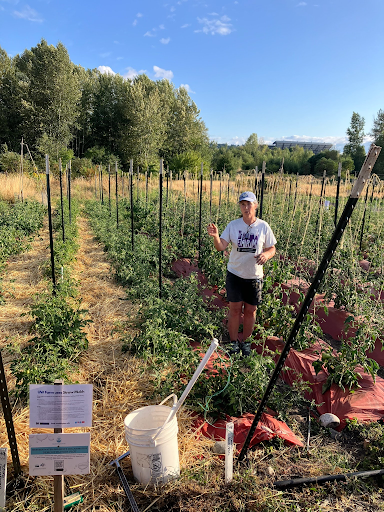
Perry Acworth, farm manager at the University of Washington Farm in Seattle, WA, worked with students to compare synthetic and organic mulches and used soil moisture sensors to inform irrigation decisions. Free coffee ground/leaf mulch and synthetic weed fabric cut irrigation needs by roughly 50%. Read the UW Farm Western Water Resilience Case Study to learn more. Photo by Hannah McDonough.
You’ve mapped your climate pattern, your water sources and losses, and your soil’s water-holding capacity. This section is where that context becomes action. The pattern-to-strategy table connects what you found to practice areas worth exploring. The checklist below will help you take stock of what you’re already doing. And the Putting It Into Practice prompts help you name one focused next step.
Start by identifying what you’re already doing to see what is working and what you can integrate into your plan.
ACTIVITY – What are you already doing?
Check the box next to the strategies you are already implementing, even partially. This is a good starting point for deciding what practices you would like to explore to improve water resilience on your farm.
Soil health & moisture conservation
- Compost / amendments
- Cover cropping
- Mulching
- No-till / reduced till
- Promote deep rooting (dry farming or deep/infrequent irrigation rather than shallow/frequent)
- Organic matter addition
- Soil surface cultivation
- Diligent weed control
Water management
- Dry farming / non-irrigated
- Efficient use of irrigation (regular system maintenance, data-driven irrigation scheduling, etc.)
- Drip / subsurface irrigation
- Rainwater collection
- Slowing and retaining water (earthworks)
- Soil moisture monitoring
- Graywater / recycled water
- Bioswales / stormwater management
Ecosystem and landscape design
- Beaver habitat or dam analogs
- Catchment ponds
- Contour strip cropping
- Earthworks / keyline design
- Hedgerows / windbreaks
- Riparian restoration
- Upland habitat management
- Terracing
Crop selection, planting, and cultivation
- Seed saving — Adapting plants to the local environment over time
- Drought-tolerant or early-maturing cultivars
- Intercropping / interplanting
- Native plants Perennials
- Direct seeding
- Transplanting
- Reduced planting density
Now look at the boxes you left unchecked. Circle any practice that could address a limitation or vulnerability you identified in your climate, water, or soil assessment. Those are your starting candidates for this season.
Before selecting practices to explore, work through these questions:
- Is any soil rehabilitation or healing needed before new practices will work well?
- What equipment and infrastructure do you currently have available?
- Were there any themes across your Section 1 activities that pointed toward a specific strategy area?
- Are there any boxes you left unchecked that could help address limitations you found in your climate, water, or soil assessment?
SEE IT IN CONTEXT – Section 4: Case Studies
The case studies in Section 4 show how growers in specific contexts have put these practices to work. They’re illustrations, not blueprints — and you may not see your scale, your region, or your crop mix reflected in what’s currently available. If your context isn’t reflected yet, your experience is what this community needs. The case studies in Section 4 show how growers in specific contexts have applied the tools in this article. They’re illustrations, not blueprints — and you may not see your climate, your scale, or your crop mix reflected in what’s currently available. Each farm is unique. If your context isn’t reflected yet, your experience is what this community needs. We’re actively building more examples. Email us at info@dryfarming.org.
RESOURCES
Oregon Agricultural Financial Program Directory – – Information on 81 programs across conservation, insurance, loans, disaster assistance & more that may provide financial support to agricultural producers in Oregon. Search for specific programs, or filter programs by the types of support, drought focus, and/or farm operation type
DFI × OSU CRAFS · Water Resilience Toolkit · Grower Pathway