BY THE END OF THIS ARTICLE, YOU WILL BE ABLE TO…
Identify at least one soil moisture monitoring method suited to your farm context and describe how you would use it to inform an irrigation decision or track the impact of a practice change.
Soil moisture sensors can help growers understand water storage and movement in the soil. Their uses include assessing:
- Site differences: Understand soil moisture dynamics at different locations on your farm.
- Soil layering and texture changes: Sensors placed above and below a texture change (slit loam over a sandy loam) can show how water moves through your soil.
- Impact of management practice: Understand how different practices (e.g. amendments, mulches, cultivation methods) impact soil moisture throughout the growing season.
- Depth of plant roots, restrictive feature or water table: A sensor reading that spikes or doesn’t move could indicate the depth where plant roots are or aren’t accessing water.
Where irrigation is available, soil moisture sensors can help growers decide when to start and stop irrigating. Data-driven irrigation decisions can significantly reduce water use and make it easier to communicate with the farm team. When a sensor indicates that irrigation is not needed, it can free growers up for other activities or reduce the labor dedicated to irrigating.
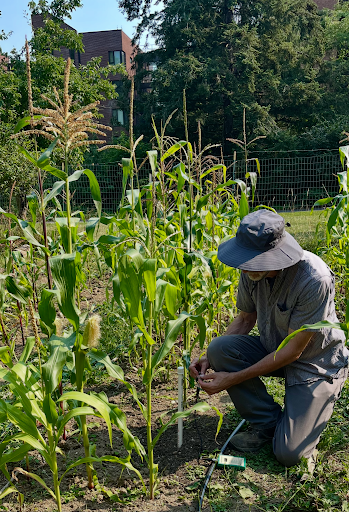
John Tuxill with the Outback Farm at Western Washington University in Bellingham, WA taking a Watermark sensor reading in their lower south field. In 2024, the soil moisture sensors there only indicated the need to irrigate three times the whole growing season, in contrast to four times a week or sixty times on average in a typical growing season. To learn more read the Outback Farm Western Water Resilience Case Study. Photo by: Ashley Rood
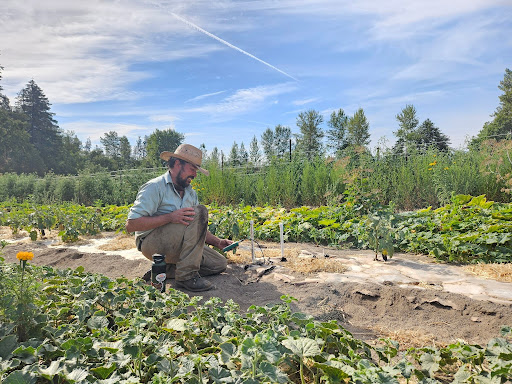
Jeff Meier of Raptor Creek Farm in Grants Pass, OR taking a Watermark sensor reading in a row where they were experimenting with paper mulch covered with straw as a means to conserve moisture on their sandy soil. They estimate that they reduced watering by 80% during the peak summer heat with data-driven irrigation decisions. To learn more read the Raptor Creek Farm Western Water Resilience Case Study. Photo by: Lucas Nebert
See the resources for a short list of easy-to-use methods for assessing soil moisture, from simple field tests to sensor-based monitoring, to help water storage and movement in your soil or make irrigation decisions.
RESOURCES
Using Soil Moisture Sensors to Increase Water Resilience on Your Farm — — Oregon State University Extension & Dry Farming Institute. 52-minute overview of practical on-farm uses of soil moisture sensors. extension.oregonstate.edu
Select the Right Irrigation Strategy (link opens a PDF) — — Oregon State University Extension. Tools and resources for selecting, designing, and managing an irrigation system. extension.oregonstate.edu
Soil Moisture Monitoring to Support Irrigation Scheduling — — Oregon State University Extension. extension.oregonstate.edu (draft)
Guide to Constructing and Using Soil Moisture Sensors — — Oregon State University Extension (draft). How to build, install, remove, read, and use Watermark soil moisture sensors. extension.oregonstate.edu
Do It Yourself Tensiometer — — University of California Agriculture and Natural Resources. Simple tensiometer design for under $55.
DFI × OSU CRAFS · Water Resilience Toolkit · Grower Pathway