Learning to read what your soil is telling you, through sight, touch, and smell
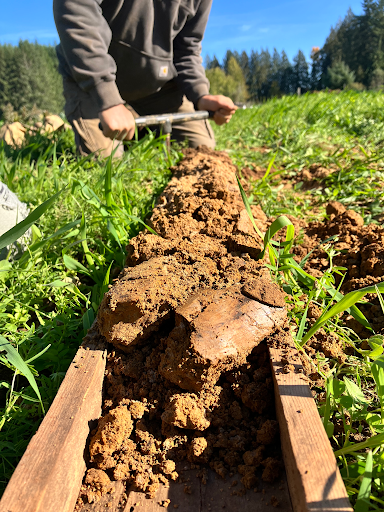
Andy Gallagher of Red Hill Soils using a soil auger to pull a 5′ soil core for Kasama Farm’s field at Headwaters Incubator Farm. To learn more read the Kasama Farm Western Water Resilience Case Study.
BY THE END OF THIS ARTICLE, YOU WILL BE ABLE TO…
Describe the physical and biological characteristics of your soil at multiple depths using your senses to make observations.
Your soil story answers a central question: how well does your soil provide your crops with plant-available water over time? “The publication’s” sponge analogy frames this well — your job here is to determine your sponge’s capacity for holding water, including how deep it is, and what factors may be limiting it.
This article walks you through how to use your senses to read your soil before making any calculations. Most experienced growers already do this intuitively. This article gives that intuition a framework and a vocabulary.
SHARED VOCABULARY
Soil health: The continued capacity of soil to function as a vital living ecosystem that sustains plants, animals, and humans. For water resilience, healthy soil means better infiltration, more water storage, and greater drought tolerance — the foundation all other practices build on.
Soil profile: The full vertical sequence of soil layers from the surface down to bedrock or a restrictive layer. What you find at 30 inches often matters more for water resilience than what you find at 6 inches.
Soil horizon: Each distinct layer within the profile, labeled by letter: A horizons are the surface layers, typically darkest and highest in organic matter; B horizons are the subsoil, where clay and minerals often accumulate; C horizons are weathered parent material. Boundaries between horizons often mark where conditions, and root behavior, shift.
Soil series: Not unlike how we name and describe different biological species, a soil series is a distinct grouping, or taxonomic designation, based on its unique physical and chemical properties, as well as its environmental context. In the U.S., soil series are defined by the USDA soil classification system.
Soil structure: How soil particles clump together into aggregates. Well-aggregated soil looks crumbly and irregular, with visible pores between clusters. These pores are where water and air move, and where roots travel. Structure is one of the most responsive soil properties — it improves relatively quickly with biological practices.
Biological activity: The presence and diversity of living organisms in the soil: bacteria, fungi, earthworms, and others. Healthy biological activity shows up as crumbly aggregates, earthworm channels, white fungal threads (mycorrhizae), fine root hairs at depth, and a rich earthy smell. These organisms drive water
ACTIVITY 1 – Choose your sample locations
Select 2–4 locations that represent the range of soil conditions on your growing site. At a minimum, you want to assess your most productive ground and the area where crops most often show water stress. Mark each location on a simple farm sketch before sampling.
Consider including:
- A representative area from each distinct soil zone on your farm
- One area that dries out earliest in the season
- One area that holds moisture longest
- Any area where crop performance has been consistently different from neighboring areas without an obvious explanation
Equipment options:
Five-foot soil core assessments can be more informative than one-foot assessments where water is limited or irrigation is unavailable. It is important to understand plant-available water-holding capacity, drainage, compaction, pH, and nutrient availability to the depth your crops will be rooting. Your local Soil and Water Conservation District (SWCD), Extension, or NRCS offices may be able to loan equipment or provide a technical assistance site visit. See the resources box at the end of this page for more information.
ACTIVITY 2 – Sensory soil assessment
This approach uses your senses to assess the soil. Use a shovel, soil auger, or probe to collect a sample. Feel moist soil between your fingers, see if it forms a ball or ribbon, watch how quickly water soaks in after a rain or irrigation, and look for aggregation, compaction, and rooting depth in a hole or soil core. This is an excellent opportunity to use the hand-texturing method — Estimating Soil Moisture by Feel and Appearance (NRCS) described in Section 2 of the publication alongside the observations below.
While digging, imagine you are plant roots working downward through the profile. Observe what’s happening at each depth:
- Texture: squeeze moist soil and try to form a ribbon. Gritty and won’t ribbon = sandy. A short crumbly ribbon = loam. A long smooth ribbon = clay-rich. Note any abrupt changes in texture as you go deeper.
- Structure and aggregation: well-aggregated soil breaks into irregular, rounded, crumb-like peds with visible pore spaces. Massive aggregates with platy or angular structure with no visible pores indicates poor structure or compaction. Dense layers that resist the auger are likely restrictive.
 |  |
- Moisture and mottling: note where the profile transitions from moist to dry. Mottling — irregular rusty or gray patches in the subsoil — indicates periodic saturation and can signal a drainage limitation or fluctuating water table.
- Root penetration: follow roots down the profile. Where do they encounter resistance? Abrupt changes in rooting often correspond to restrictive layers even when the texture change is subtle.
- Biological activity: earthworm channels, visible fine roots throughout, white fungal threads (mycorrhizae), and crumbly well-aggregated structure all indicate healthy biology and good water and nutrient cycling.
- Smell: healthy, biologically active soil has a rich earthy smell. Sour, sulfurous, or swampy odors suggest waterlogging, compaction, or depleted microbial communities.
| LOCATION 1: | |||||
|---|---|---|---|---|---|
| Depth | Horizon(A, B, C…) | Texture (ribbon test) | Structure /aggregation | Color and moisture Roots present? | Notes /constraints |
| 0–12 in | |||||
| 12–24 in | |||||
| 24–48 in | |||||
| Below 48 in (if reachable) | |||||
| LOCATION 2: | |||||
|---|---|---|---|---|---|
| Depth | Horizon(A, B, C…) | Texture (ribbon test) | Structure /aggregation | Color and moisture Roots present? | Notes /constraints |
| 0–12 in | |||||
| 12–24 in | |||||
| 24–48 in | |||||
| Below 48 in (if reachable) | |||||
SEE IT IN CONTEXT – Section 4: Case Studies
The Kasama Farm case study in Section 4 shows how a five-foot soil core assessment revealed unexpected soil conditions. Read the Kasama Farm Western Water Resilience Case Study to learn more. The case studies in Section 4 show how growers in specific contexts have applied the tools in this article. They’re illustrations, not blueprints — and you may not see your climate, your scale, or your crop mix reflected in what’s currently available. Each farm is unique. If your context isn’t reflected yet, your experience is what this community needs. We’re actively building more examples. Email us at info@dryfarming.org.
From sensory observation to strategy
After completing your profile observation, find the row or rows that most closely match what you found. You may recognize your farm in more than one. This table connects your observations to a starting place, not a final answer.
| When I dug into my soil, I observed… | ✓ | Strategy areas worth exploring first |
|---|---|---|
| Roots stop or deflect noticeably at 12–24 inches, and the layer below is dense or resists the auger | □ | Start by addressing what’s stopping the roots before investing in surface practices: deep-rooted cover crops (tillage radish, chicory, tap-rooted legumes), subsoil aeration, NRCS technical assistance for earthworks. Until roots can go deeper, water storage is capped at that depth. |
| Soil at depth breaks into large blocks with few visible pores; earthworm channels are scarce or absent | □ | Biological practices: diverse cover crop mixes, compost rather than synthetic fertilizers, minimal soil disturbance, permanent living pathways. Soil structure responds to management faster than texture does, and biology is the driver. |
| Rusty orange or grayish patches (mottling) appear in the subsoil | □ | Drainage management alongside moisture retention: earthworks, bioswales, contour strip cropping; organic matter building to improve infiltration and drainage in the wet season and moisture retention in the dry season. |
| The profile stays visibly moist well into summer; roots extend 30 inches or more | □ | This site has water resilience potential: consider dry farming trials with appropriate varieties and planting timing. Focus assessment on variety selection and pre-season soil moisture banking. |
| The profile transitions from moist to dry within the top 8–12 inches by early summer | □ | Mulch and cover crops to slow surface evaporation; organic matter building to increase surface layer retention; drip irrigation to deliver water efficiently where roots are active. |
| Conditions vary significantly across the farm — different textures, rooting depths, or moisture behavior in different areas | □ | Map the variation before investing uniformly. Different zones may call for different strategies: dry farming on deeper or moister areas, intensive soil building on more limited areas. The assessment effort here saves wasted investment later. |
PUTTING IT INTO PRACTICE
- What was the most significant change you observed as you went deeper? Consider texture, moisture, and/or root presence.
- Did you find any evidence of a restrictive layer? At what depth?
- What did your observations tell you about the biological health of your soil?
Carry forward: Your effective rooting depth at each location and any restrictive layers you found carry into Article 3B for the AWHC calculation.
RESOURCES
Site Factors Related to Dry Farm Vegetable Productivity and Quality in the Willamette Valley of Oregon — — Understanding and Evaluating Site Factors Related to Dry-Farmed Vegetable Productivity. Sections 1 and 2 are the foundational reading for all three soil articles.
Estimating Soil Moisture by Feel and Appearance — — NRCS. Illustrated field guide to texture-by-feel and ribbon test methods. nrcs.usda.gov
A Guide to Collecting Soil Samples for Farms and Gardens — — OSU Extension. Guidance on sample collection methods for different assessment purposes.
SWCD Soil Health Programs: Equipment, Soil Testing, Grants to Share — — Living directory of SWCD Soil Health Programs in Oregon including equipment sharing, soil testing, and grants.
Facilitator Notes (click to view)
This article is about building observational confidence. This article’s job is to make growers feel competent and curious before they get to any calculations.
Name what they already know. Growers with experience and relationship with a piece of land often have detailed, accurate observations about how different areas behave. Before introducing any frameworks, ask what they’ve noticed. The framework then confirms and extends what they already know.
DFI × OSU CRAFS · Water Resilience Toolkit · Grower Pathway