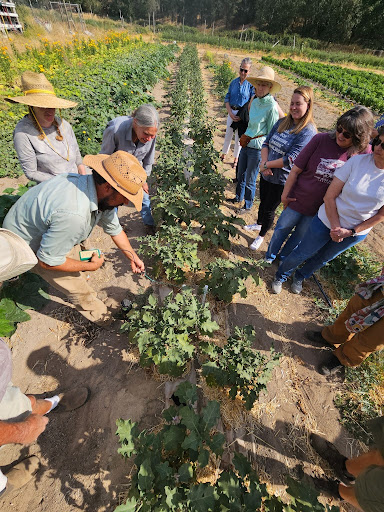
Jeff Meier of Raptor Creek Farm demonstrates a watermark soil moisture sensor reading with field day participants. Grants Pass, OR. Read the Raptor Creek Farm Western Water Resilience Case Study (link opens a PDF) to learn more. Photo by Lucas Nebert
This article assumes you’ve read Article 1 in this section and have selected on-farm demonstrations as your next step.
BY THE END OF THIS ARTICLE, YOU WILL BE ABLE TO…
- Describe the purpose and basic structure of an on‑farm demonstration in the context of water resilience.
- Identify at least one case study and one external resource to support your demonstration planning.
- Name one potential host site and a concrete next step toward implementing a demonstration.
On-farm demonstrations provide a direct, tangible way for farmers and land stewards to experiment with new practices, whether formally or informally. Demonstrations typically have a standardized design and protocol with a few farmers/land stewards experimenting with the same practice on their land.
Based on lessons learned from six farms and a decade of dry farming work in Oregon through the Dry Farming Institute, the Water Resilience Case Studies show how on-farm demonstration work in practice shares the process, tools, and resources that have been most helpful for producers experimenting with water resilience projects on their farms.
RESOURCES
How to Conduct Research on Your Farm or Ranch — — SARE’s comprehensive guide to on-farm research and demonstration design. SARE has developed a robust publication on how best to both conduct on-farm research and host demonstrations on your farm. Consider diving into their resources if you want to explore in-depth resources for conducting research on your farm or ranch.
2024 Western Water Resilience Case Studies — — Six on-farm demonstration case studies from across the West Coast. Essential reading before planning a demonstration.