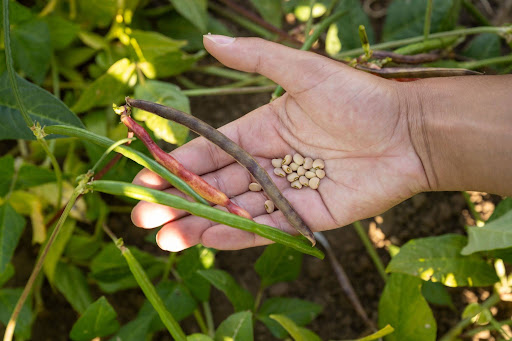
Dry-farmed cowpeas in a field. Photo by Shawn Linehan.
BY THE END OF THIS ARTICLE, YOU WILL BE ABLE TO…
- Distinguish between goals, outcomes, impacts, metrics, and qualitative data when describing your work.
- Choose a simple, sustainable method to track progress over at least one season.
- Define one short‑term indicator that would tell you your community of practice is working.
- Describe how you will share what you’re learning with growers, partners, or funders
SHARED VOCABULARY
Goals: What you want to achieve. Goals give your community direction and a basis for evaluating whether the work is moving where you intended. They should be specific enough to be meaningful and flexible enough to evolve.
Outcomes: The results or effects of your activities. Outcomes describe what changed — in knowledge, behavior, relationships, or conditions — as a result of the work.
Impacts: The longer-term, broader effects of the work, often extending beyond a single project or funding cycle. Impacts are tracked through indicators across environmental, social, and economic dimensions.
Metrics: Quantitative measures that give you information about your activities. Examples: number of farmers attending a field day, acres under a new practice, gallons of water conserved.
Qualitative data: Information about characteristics, qualities, and experiences rather than numbers. Examples: grower descriptions of how their confidence changed, facilitator notes on what shifted in a conversation, stories of unexpected outcomes
ACTIVITY – Assess your impact
If you plan to develop on-farm demonstrations or host field days, you might consider how you will assess your impact. Consider taking time to think about how you might assess what you have learned, and use that feedback to adapt, learn from, and implement new protocols, practices, and approaches. Some questions you might want to ask:
- What are your short, medium, and long-term goals for your water resilience community of practice?
The filled out rows show an example farm. Add your own information in the blank rows below.
| Short-term goals (measured in one year or less) | Medium-term goals (measured over the course of 1-3 years) | Long-term goals (goals that may be beyond the life of the project/effort) |
|---|---|---|
| Avg. annual rainfall | 39.3 in | Drought timing |
| Stream / water rights | 0 | Junior water rights |
| Well | 2 gal/min | Tends to dry out by August |
| Cisterns / tanks | 2,000 gal | Only enough to irrigate starts in the spring |
| Municipal water | ||
- What are the outcomes you want to achieve with your community of practice?
- What metrics will tell you whether you’re moving in the right direction?
- What data, stories, observations, reflections, would help you tell the story of the work’s impact?
Collecting evaluation data and tracking impacts may help you to be more successful in securing funding for the work. Many people hire consultants or work with evaluation experts at a university to conduct comprehensive evaluation efforts. However, there are many scales at which you might implement an evaluation and some of it can be done in-house with purpose and intention.
BEFORE YOUR NEXT SESSION
Work through these prompts before meeting with growers or convening your group. They will help you clarify your resources, evaluation approach, and early indicators of success:
- Identify a realistic funding source: from the list above, which funding source is most feasible for your current stage of work? Name it and note the next concrete step you’ll take to explore it.
- Choose a simple, sustainable evaluation approach: What is the simplest evaluation method you could implement right now – one you could realistically sustain over a full season?
- Define a short‑term success indicator: One year from now, what short‑term goal or outcome would tell you that your community of practice is working?
Carry forward: Your funding lead and evaluation approach carry into Section 4, where you’ll connect with the broader DFI community and share what you’re building.
RESOURCES
BetterEvaluation — — Accessible introduction to evaluation concepts and approaches.