Funding your work, evaluating your impact, and sustaining your community over time.
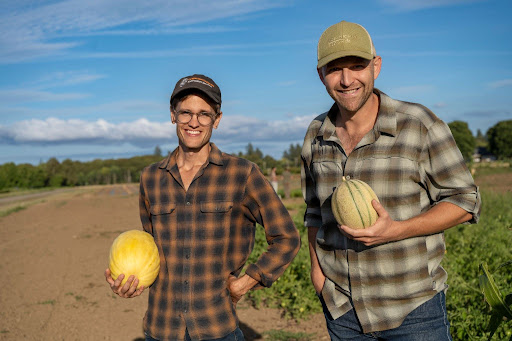
Photo of Lucas Nebert, OSU agricultural extension professional, and Joey Staub, Product Innovation Manager with Organically Grown Company, at a field day holding dry-farmed melons. Photo by Shawn Linehan.
BY THE END OF THIS ARTICLE, YOU WILL BE ABLE TO…
- Identify at least one realistic funding or support source that matches your context.
- Name the next concrete step you will take to pursue that funding or support.
Building a community of practice around water resilience, or even just engaging with other farmers in peer-to-peer learning, can take energy, resources, and time to support, especially over the long-term. There are a multitude of ever-changing resources out there, but we wanted to highlight some resources that we think are a good place to start, from purchasing seeds adapted for your region/site context, to selecting water sensors and other in-field tools to some ideas on how to fund your collaborative work.
FUNDING RESOURCES
Small Farm Funding Guide — — USDA funding resources for small farms, across conservation, insurance, loans, and disaster assistance.
SARE On-Farm Research Grants — — Funding for on-farm research, available to farmers and service providers who work with farmers.
Oregon AgWater Funding Guide — — 81 programs across conservation, insurance, loans, and disaster assistance specifically for Oregon.
Funding Water Resilient Work — — DFI workshop on funding strategies for water resilience work with farmers (recorded 12/5/2024).
Oregon SWCD Resources — — Oregon Department of Agriculture links to SWCD programs, soil health grants, and equipment sharing.
Outside Oregon: search for your county’s Soil and Water Conservation District or Resource Conservation District to find local equipment programs, cost-share opportunities, and technical assistance.