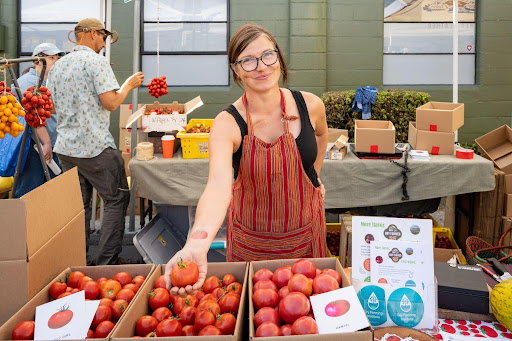
Amy Garret, DFI’s founder and Program Director, shares the taste of dry-farmed tomatoes at an event. Photo by Shawn Linehan.
BY THE END OF THIS ARTICLE, YOU WILL BE ABLE TO…
- Define the boundaries of a community of practice suited to your region.
- Name at least one ground rule, goal, and leadership role for your community of practice.
- Identify the facilitation approach most appropriate for your group.
As you get started in your efforts to facilitate a community of practice, it seems important to remind you of a few things as you get started. Facilitating a collaborative group of people in co-creative ways is not rocket science, but it can be informed by and improved by keeping some key facilitation best practices in mind. For instance,
- Explore & define the boundaries of your community of practice (COP). What geography makes sense? What demand do you have from growers and service providers? Who are you seeking to serve and engage, and why?
- Establish ground rules early – Intentionally convene your COP virtually or in-person and set some ground rules and expectations on how you want to communicate, share information, resolve conflicts, and clarify roles and responsibilities, including leadership!
- Set goals, then plan to revisit them – Set clear goals for what your group wants to work on; these goals can change and evolve over time, but starting with a clear roadmap can support your group’s long-term success
- Build in ways to share progress – Determine how you want to share progress and learn as you go along. Examples include:
- Host events like field days, demonstrations, peer-to-peer network sharing (link to other spots in toolkit)
- Host winter meetings (link to DFI handout) or other gatherings to share learning, get feedback, and make plans for the future
- Distribute leadership: Explore leadership roles and responsibilities and build redundancy so that your group is not overly reliant on one person to keep the community going.
RESOURCES
Facilitation Skills — — Community Tool Box provides a practical guide to group facilitation.
Forming Ground Rules — — CLEE resource on creating norms for collaborative groups.
Conflict Resolution — — Community Toolbox: how to navigate conflict in collaborative settings.
Distributed Leadership — — Distributed Leadership as a Sustainable and Inclusive Leadership Approach