Building a Community of Practice around water resilience in your region
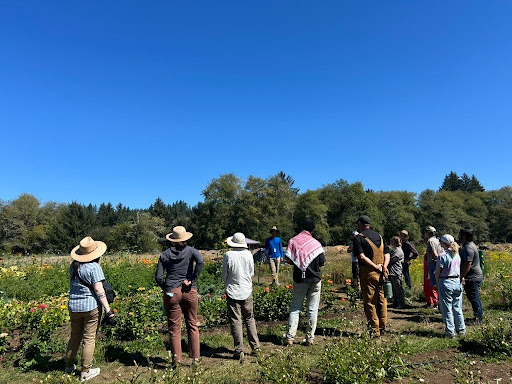
Field day participants gather in the field at Tel-tvm’. Read Tel-tvm’ Western Water Resilience Case Study (link opens a PDF) to learn more. Photo by Amy Garrett
BY THE END OF THIS ARTICLE, YOU WILL BE ABLE TO…
- Name at least one group or network that could form the core of that community.
SHARED VOCABULARY
Community of practice: A group that convenes, in person or virtually, over a sustained period to share knowledge, experience, and resources in a decentralized way. Unlike a one-time workshop, a community of practice builds collective understanding over time. Wenger defines it as ‘groups of people who share a concern or a passion for something they do and learn how to do it better as they interact regularly.’
Peer-to-peer network: A group of individuals who gather as peers to share information and resources. The model operates on the principle that everyone has something to offer and something to learn — distinct from a top-down, expert-driven approach.
Participatory learning: An approach that centers the experience and expertise of the participants. Rather than positioning the facilitator as the primary knowledge source, participatory learning draws out and builds on what participants already know. It’s well-suited to communities navigating complex, place-specific challenges like water scarcity.
Why a community of practice supports water resilience
Farmers are more likely to adopt and sustain new practices when they learn alongside peers, not just from experts. Research consistently shows that participatory and peer-based learning environments produce stronger practice adoption and a greater sense of connection — both of which matter as farmers face increasing uncertainty around water availability.
A community of practice is well-suited to this work because it doesn’t require a single expert to have all the answers. It creates the conditions for farmers to learn from each other, share what’s working, and adapt as conditions change. That flexibility is exactly what water resilience requires.
RESOURCES
Introduction to Communities of Practice — — Wenger-Traynor provides a deeper dive into what communities of practice are and how we can understand their application
Peer Network Training and Toolkit — — American Farmland Trust – robust resource from American Farmland Trust outlining how to engage, train, and develop peer-to-peer networks to reach a diverse group of farmers
Climate SMART Adoption Fact Sheet — — Synthesis of literature that guides our understanding about how farmers are making decisions about adapting to climate change, including what barriers they face.
Creating farmer networks — — Oregon State University toolkit for promoting vibrant farm communities